Subterranean Venues

Performance Beneath the Street

Removed from urban acoustic contamination, underground caverns, salt deposits, and defunct water reservoirs produce reverberation fields that alter how musicians compose and perform.

Isolation from Surface Noise

In standard urban architecture, millions of dollars are expended isolating concert halls from subway rumbles, aircraft overflights, and vehicle traffic. Subterranean chambers possess a natural structural advantage: hundreds of thousands of tons of earth, rock, and shale act as an acoustic low-pass filter, extinguishing ambient noise down to NC-15 or lower.

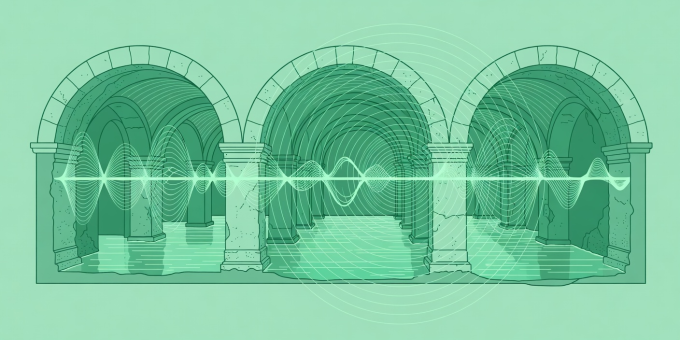
However, subterranean architecture introduces radical boundary conditions. Hard, non-porous rock or wet hydraulic lime mortar reflects up to 98% of incident sound energy. In such environments, sound does not merely decay; it recirculates, producing dense harmonic stacking where notes played seconds apart coexist simultaneously.

Flat mint-and-green vector architectural section showing soundwave propagation through subterranean arched vaults
Sectional study of vaulted reflection paths in an underground masonry cistern. Mark diagrams as explanatory rather than measured acoustic simulations.
Chamber Studies

Subterranean Sound Spaces Compared

From ancient municipal water infrastructure to volcanic rock cathedrals, underground spaces challenge conventional notions of tempo and instrumentation.

Masonry Reservoir
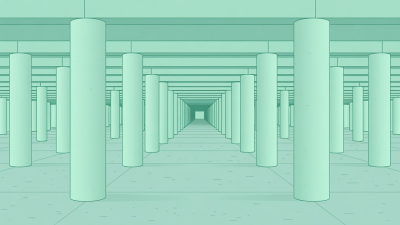
Mint-tinted vector rendering of Houston Buffalo Bayou Cistern concrete columns repeating into vanishing point

Buffalo Bayou Park Cistern, Houston

Originally built in 1926 as a municipal drinking reservoir with 221 slender, 25-foot concrete columns, this 87,500-square-foot underground hall boasts an uninterrupted 17-second reverberation decay time. Sound artists design site-specific spatial installations where single vocal whispers linger in space long after emission.

Decay Constant: 17 seconds average decay at 500 Hz.
Halite Salt Excavation
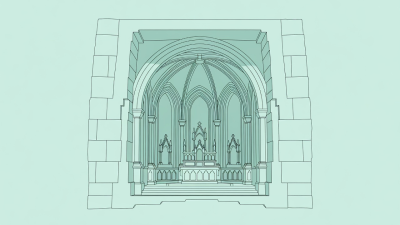
Flat vector architectural section of St Kinga Chapel carved inside Wieliczka Salt Mine

Wieliczka Salt Mine, Poland

Over 100 meters underground lies the Chapel of St. Kinga, entirely carved out of solid rock salt. Halite has unique physical density and micro-crystallographic facets that absorb less high-frequency sound than bare concrete while dampening extreme harshness, yielding warm choral clarity for sacred concerts.

Material Profile: Solid sodium chloride crystalline walls with chandeliers of salt rock.
Volcanic Tunnel Chamber
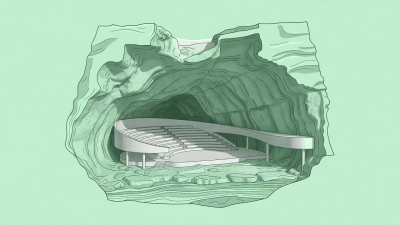
Architectural cutaway of César Manrique's volcanic lava tube auditorium at Jameos del Agua Lanzarote

Jameos del Agua, Lanzarote

Conceived by artist César Manrique inside a natural volcanic lava tube, this 600-seat auditorium combines porous basaltic rock walls with gentle natural gradients. The spongy, highly irregular lava surfaces act as natural broadband sound diffusers, preventing harsh reflections without artificial panels.

Natural Diffusion: Highly porous volcanic basalt naturally eliminates flutter echo.
Acoustic Consequences

How Subterranean Space Dictates Musical Tempo

In chambers with decay times exceeding six seconds, standard classical allegros become incomprehensible cacophony. The composer or performer must fundamentally slow their tempo to match the space's resonant frequency. Pauline Oliveros formulated the principles of "Deep Listening" specifically while recording in the Fort Worden cistern in 1988: the room does not merely amplify sound; the room itself becomes an equal duet partner.

Explore next: Waterborne and floating stages →