Acoustic Typologies

Halls with a Sonic Signature

Every concert hall is a resonant instrument built at the scale of thousands of cubic meters. Here we compare the three major structural philosophies: shoebox, vineyard, and parametric diffusion.

The Physical Constraints of Symphonic Clarity

A concert hall must accomplish two physically contradictory goals: it must provide strong, unblurred direct sound so individual orchestral sections remain distinct, while enveloping the listener in a diffuse reverberant field that creates a sensation of spaciousness. If the hall is too narrow or dry, the music feels thin and clinical; if it is too vast or poorly angled, delicate woodwinds blur into an undifferentiated sonic wash.

For more than a century, acousticians have wrestled with the spatial geometry of the hall footprint. Wallace Clement Sabine, who established quantitative architectural acoustics at Harvard at the end of the nineteenth century, demonstrated that reverberation time is directly proportional to a hall’s total cubic volume and inversely proportional to the aggregate absorption of all interior surfaces, including human bodies.

Mint-toned comparative vector cutaways contrasting parallel rectangular shoebox reflections against terraced vineyard geometry
Diagrammatic comparison of lateral wall reflection patterns between rectangular shoeboxes and vineyard terraces. Mark diagrams as explanatory rather than measured acoustic simulations.

Comparative Analysis

Three Iconic Venues Analyzed

We examine the concrete parameters, materials, and acoustic trade-offs of three hall typologies spanning three different centuries.

Rectangular Shoebox
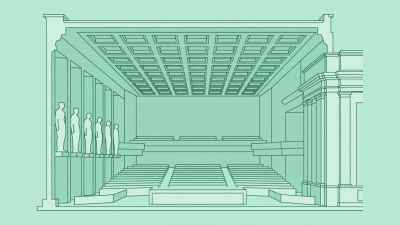
Flat mint vector cutaway of Boston Symphony Hall showing side statues and deep coffered ceiling

Boston Symphony Hall (1900)

Designed by McKim, Mead & White with Sabine’s calculations, this hall proved that a 1:1:2 proportional ratio (height to width to length) delivers exceptional lateral reflection density. The plaster reliefs, niches, and gilded classical statues serve a functional acoustic purpose: scattering high-frequency flutter echoes without dulling harmonic overtones.

Measured Reverberation: ~1.9 seconds (occupied) with high bass warmth ratio.
Surround Vineyard
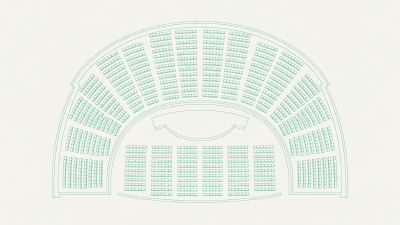
Vector drawing of Suntory Hall Tokyo showing vineyard terrace seating blocks facing the central podium

Suntory Hall, Tokyo (1986)

Consulted by legendary acoustician Minoru Nagata with Herbert von Karajan, Suntory Hall embraced the vineyard concept first realized in Berlin. Terraced concrete barriers divide the 2,006 seats into intimate clusters, each backed by rigid low parapets that act as secondary reflection surfaces directly behind listener heads.

Spatial Advantage: Ensures no listener is more than 30 meters from the conductor.
Parametric Relief
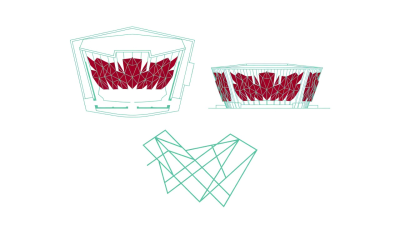
Flat mint architectural diagram of Harpa Reykjavik Eldborg hall with faceted crimson-forest acoustic baffles

Eldborg, Harpa Reykjavik (2011)

Designed by Henning Larsen and Batteríið Architects with Artec Consultants, Eldborg employs mechanical acoustic chambers and massive vertical concrete reverberation doors hidden behind faceted wall grilles. The room volume can be physically expanded or contracted to tailor decay to the repertoire.

Variable Volume: 30% volume adjustment via acoustic dampening curtains.
Hall Name Typology Seat Capacity Primary Acoustic Advantage Notable Trade-Off
Vienna Musikverein Shoebox 1,744 Enveloping lateral cross-reflections Restricted sightlines from deep rear stalls
Berlin Philharmonie Vineyard 2,440 Superior sightlines and spatial proximity Complex balancing of rear orchestra instruments
Elbphilharmonie Hamburg Vineyard / Algorithmic 2,100 Sub-millimeter diffuse high scattering Demands extraordinary precision from performers
Concertgebouw, Amsterdam Modified Shoebox 1,974 Deep resonant sustain for brass and organ Long reverberation challenges rapid speech
Curatorial Summary

Why the Ideal Hall Does Not Exist

Acoustic design cannot be reduced to a single objective score. A venue engineered to deliver the crystalline contrapuntal separation required for a Bach fugue will sound arid during a Mahler symphony. Conversely, a hall optimized for choral resonance will turn percussion attacks into muddy smears. The greatest concert architecture embraces these physical limitations, accepting that character is born from specific geometric compromises.

Next chapter: Subterranean resonant chambers →